

How to earn real money online promoting products you believe in — no experience needed.
I remember the first time I heard about affiliate marketing. Someone in a WhatsApp group shared a screenshot of their dashboard showing KSh 47,000 earned in a single month — just from sharing links. My first thought was: “This has to be a scam.”
It wasn’t. And after digging deep into how it actually works, I realized affiliate marketing is one of the most legitimate ways to earn money online in Kenya today. It costs almost nothing to start, you don’t need to create a product, and you can do it from a cheap laptop in Nairobi, Kisumu, Mombasa, or anywhere with a decent internet connection.
In this guide, I’m going to walk you through everything step by step — from the very basics to your first commission. No fluff, no vague tips. Just real, actionable steps built for the Kenyan context. Whether you’re a student, a job seeker, a mama mboga who wants extra income, or a professional wanting a side hustle, this guide is for you.
1. What Is Affiliate Marketing?
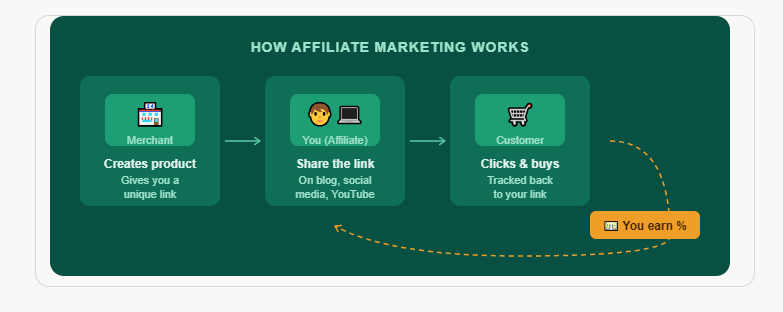
Affiliate marketing is a business model where you earn a commission by promoting someone else’s product or service. You don’t create the product. You don’t handle shipping or customer complaints. You simply connect buyers with sellers, and when a sale happens through your unique link, you get a cut of the money.
Think of it like being a salesperson who works online. A shop in Westlands doesn’t have time to reach customers in Eldoret, but you do — through your blog, TikTok page, YouTube channel, or WhatsApp group. Every time someone you refer makes a purchase, the merchant pays you a commission. Simple as that.
The best part? You don’t need to be physically present, you don’t need to stock anything, and you can promote multiple products at once. Your links work 24 hours a day, 7 days a week. While you’re sleeping, eating nyama choma with friends, or stuck in Nairobi traffic, your links are still potentially making you money.
Globally, affiliate marketing is a multi-billion-dollar industry. In Kenya, the industry is still young — which is actually good news for you. It means less competition, easier ranking on Google, and easier growth on social media. The Kenyan digital economy has exploded, with over 22 million internet users and M-Pesa making online payments seamless. This is the perfect environment for affiliate marketing to thrive.
Let me be clear about one thing: affiliate marketing is not a get-rich-quick scheme. It takes real work, especially in the first few months. But with consistency, it can build into a passive income stream that pays you month after month. I’ve seen young Kenyans go from zero to earning KSh 50,000 to KSh 200,000 per month within a year. That’s the kind of result that’s possible when you take this seriously.
2. How Does It Work in Kenya?
The mechanics are beautifully simple. You sign up for an affiliate program, get a unique tracking link (sometimes called a referral link), and then share that link wherever you have an audience. When someone clicks that link and completes a purchase, the system records it and credits you with a commission. You can see everything inside your affiliate dashboard — clicks, conversions, and earnings.
In Kenya specifically, the process works the same as anywhere else in the world, but there are a few local considerations. Most international affiliate programs pay via PayPal or direct bank transfer. You’ll want to set up a PayPal account or use a service like Payoneer or Wise to receive your money, and then convert it to KSh and withdraw via M-Pesa or your local bank account. We’ll cover this in detail in the payments section.
Kenya-based programs are even easier — some pay directly to M-Pesa. Companies like Jumia Kenya, Kilimall, and local insurance companies all have affiliate programs where you get paid directly in Kenyan shillings. These are a great starting point for beginners because you understand the products, the audience, and the payment system already.
The tracking technology behind affiliate marketing is simple but clever. When you click an affiliate link, a small file called a “cookie” is saved in your browser. This cookie tells the merchant’s system that you sent that visitor. Most cookies last 30 to 90 days, meaning if someone clicks your link today but only buys three weeks later, you still get the commission. That’s the magic of cookie-based tracking.
One important thing to understand is that different programs have different commission structures. Some pay a flat fee per sale (like KSh 500 for every insurance policy sold). Others pay a percentage of the sale value — for example, 10% of a KSh 10,000 product is KSh 1,000 per sale. Digital products like courses and software often pay the highest commissions, sometimes 30–50% per sale. Understanding commission structures will help you choose programs that give you the best return for your effort.
3. Best Affiliate Programs for Kenyans
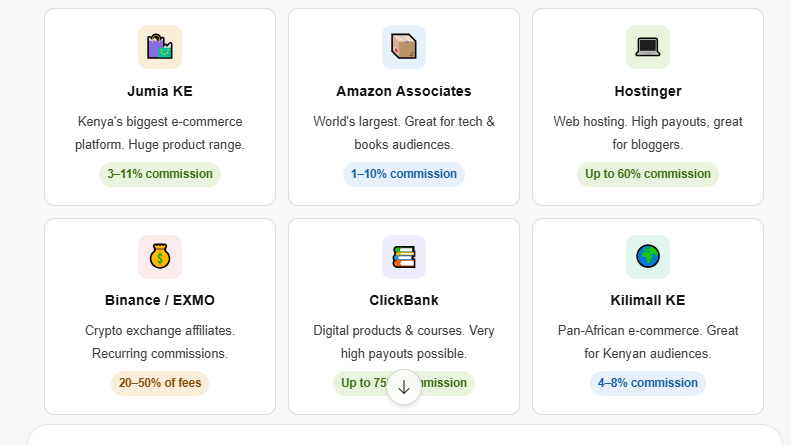
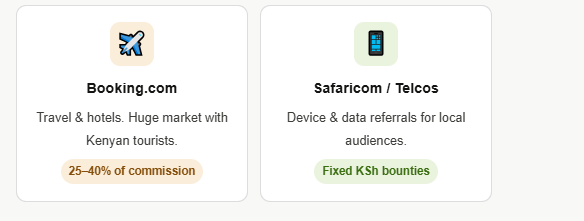
When you’re just starting out, I recommend starting with Jumia Kenya — it’s the easiest to understand because most Kenyans already know and trust the brand. The commission rates range from 3% to 11% depending on the product category, and they pay via bank transfer or M-Pesa. You can sign up at the Jumia Partner Centre and start sharing links the same day.
For those interested in earning in USD, Hostinger’s affiliate program is exceptional. You earn up to 60% commission on every hosting sale, which is an incredibly high rate. If you run a blog that teaches people how to start websites or online businesses, this program can be extremely lucrative. I know Kenyan bloggers who earn over $500 monthly just from Hostinger referrals alone.
ClickBank is a marketplace of digital products — mostly online courses, eBooks, and software tools. The commission rates are insanely high, sometimes 50–75% per sale. The downside is that many products on ClickBank are for international audiences, so you’ll need to create content that attracts traffic from countries like the US or UK. This is totally doable, and many Kenyans do it successfully.
💡 Pro Tip: Start with one program
Beginners often make the mistake of joining 10 affiliate programs at once and getting overwhelmed. Pick one or two programs in your niche, learn them deeply, and master them before adding more. Focus beats variety every time.
For digital marketers and tech bloggers, software affiliate programs are gold. Tools like SEMrush, ConvertKit, Canva Pro, and Grammarly all have affiliate programs with generous recurring commissions. “Recurring” means you earn money every month as long as your referred customer keeps paying their subscription. One good referral can pay you for years.
The key thing to remember when choosing a program is alignment. Promote products that are relevant to your niche and that you genuinely trust. Your audience can tell when you’re recommending something you don’t believe in, and it destroys trust. Trust is everything in affiliate marketing. Once your audience trusts your recommendations, conversions become much easier and more consistent.
4. Picking a Profitable Niche
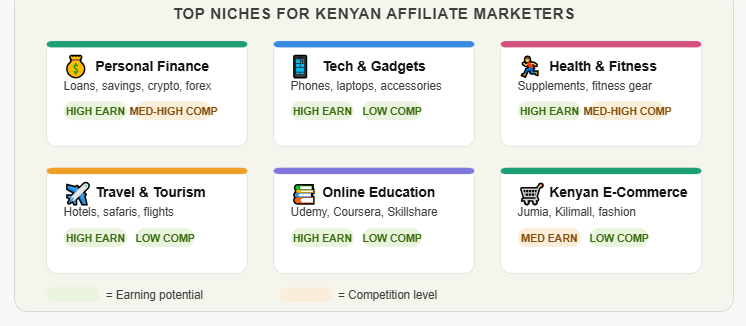
Your niche is the specific topic or industry you’re going to focus on. It determines who your audience is, what products you promote, and how much money you can make. Choosing the right niche is one of the most important decisions you’ll make as an affiliate marketer, so I want to walk you through it carefully.
The golden rule of niche selection is to find the sweet spot between passion, knowledge, and profitability. Passion alone isn’t enough — there must be affiliate products to promote and people willing to spend money in that space. Knowledge alone isn’t enough either — if nobody is searching for that topic online, you’ll create content that nobody reads. And profitability alone leads you to promoting products you hate, which kills your motivation within months.
For Kenyan audiences, some of the hottest niches right now include personal finance (budgeting, savings, cryptocurrency, mobile money), online jobs and side hustles, tech gadgets and smartphones, health and wellness, and travel and tourism. These niches all have large audiences, active search volume, and high-paying affiliate programs. They’re not oversaturated like “weight loss” or “make money online” in international markets.
Don’t be afraid to go hyper-local. A blog about “best smartphones under KSh 30,000 in Kenya” or “how to invest with M-Pesa” has almost zero international competition. You’ll rank on Google much faster, and the audience you attract will be perfectly primed to click your affiliate links. Local specificity is a superpower for Kenyan affiliates that most Western marketers can’t compete with.
When you’ve picked a niche, do a quick profitability check. Search for that niche on Google and look at whether ads are showing up. If companies are paying for Google ads in your niche, that means there’s money being spent. Then search for affiliate programs in your niche and check the commission rates. If you can find programs paying 10%+ commissions, you’ve found a niche worth building in.
5. Setting Up Your Platform
Your platform is where you’ll share your affiliate links and attract an audience. You have several options, and the best one depends on your skills, budget, and content style. Let me break down the main options clearly.
Option A — A Blog/Website is the most powerful long-term platform. A blog lets you write articles that rank on Google and bring you passive traffic for years. You’ll need to buy a domain name (around KSh 1,000–1,500 per year) and web hosting (Hostinger is great and costs around KSh 3,000–4,000 per year). Use WordPress to build your site — it’s free and powers 43% of all websites on the internet. Yes, there’s a small upfront cost, but the long-term ROI is enormous.
Option B — YouTube Channel is perfect if you’re comfortable on camera or can do voice-overs on screen-share videos. YouTube is the second-largest search engine in the world, and there’s massive appetite in Kenya for videos about tech reviews, finance tips, cooking, beauty, and more. Put your affiliate links in the video description and watch clicks roll in. Best of all, YouTube is completely free to use.
Option C — Social Media (TikTok, Instagram, Facebook) requires zero upfront investment and can grow fast. TikTok especially is a goldmine right now — short, helpful videos can go viral and send thousands of clicks to your affiliate links overnight. The downside is that social media traffic is unpredictable and you don’t own your audience. A platform change can wipe out your following overnight. Use social media to grow traffic, but always try to build an email list or blog as your long-term asset.
1. Choose your platform
Blog for long-term SEO, YouTube for video content, social media for fast growth. Pick one and focus.
2. Get your domain and hosting (if building a blog)
Buy a .co.ke or .com domain from Domains.co.ke or Namecheap. Host with Hostinger or Bluehost.
3. Install WordPress and a clean theme
Use Astra or GeneratePress — they’re fast, free, and perfect for affiliate blogs.
4. Install essential plugins
RankMath SEO, ThirstyAffiliates (for link management), WP Rocket (for speed), and Akismet (for spam).
5. Create your core pages
About page, Contact page, Privacy Policy, and Affiliate Disclosure. These are required by most affiliate programs.
One thing beginners often skip is the affiliate disclosure. This is a short statement telling your readers that you may earn a commission if they buy through your links. Not only is this legally required in many countries, but it’s also ethically right. Surprisingly, being transparent about how you earn money actually increases trust with your audience, not decreases it. Put a disclosure at the top of every review post and in your site footer.
6. Creating Content That Converts
Content is the engine that drives affiliate marketing. Without good content, you have no audience. Without an audience, your links get zero clicks. Creating content that actually converts readers into buyers is a skill — and I’m going to teach you the most important principles right now.
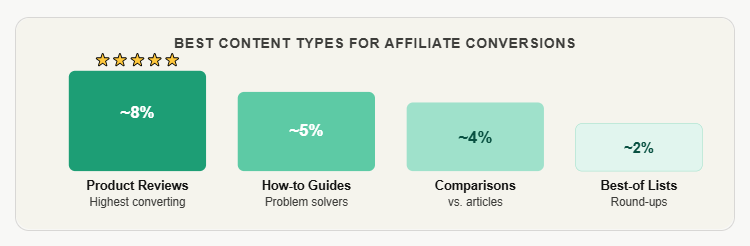
The highest-converting content type in affiliate marketing is the product review. When someone searches “Samsung Galaxy A55 review Kenya” or “best laptop for students in Kenya,” they’re already in buying mode. They just need a trustworthy, detailed review to push them over the edge. These are your golden pages. Write detailed, honest reviews. Talk about pros AND cons. Share real-world use cases. Include clear call-to-action buttons with your affiliate link. A good review article can convert at 5–10%, meaning 1 in 10 to 20 visitors will click and potentially buy.
The second most powerful content type is the “best of” list — articles like “Best Smartphones Under KSh 30,000 in Kenya” or “Top 5 Hosting Services for Kenyan Bloggers.” These articles capture people searching for a recommendation, and you can include multiple affiliate links in a single post. They’re also great for SEO because they target specific, high-intent keywords.
How-to guides are powerful because they attract people with problems looking for solutions. “How to Start Blogging in Kenya” can naturally lead to recommending hosting, WordPress themes, and SEO tools — all of which have affiliate programs. The trick is to write the guide genuinely helpfully first, then weave in product recommendations naturally where they fit. Don’t force products into your content — let them flow in where they actually solve a problem.
Whatever you write, follow these golden rules of affiliate content: be specific, be honest, be helpful, and always think about search intent. What does someone searching for this topic actually want? Give them that — and then give them a great product recommendation. That formula works every single time.
📝 Content Formula That Works
Hook (tell them what they’ll get) → Problem (identify their pain) → Solution (introduce the product) → Proof (show results or reviews) → Call to Action (clear button or link). Use this structure in every review post.
7. Driving Traffic to Your Links
You can have the best content in the world, but if nobody sees it, you’ll earn nothing. Traffic is the lifeblood of affiliate marketing. There are two types of traffic: free (organic) and paid. As a beginner, I strongly recommend starting with free traffic methods while you’re learning the ropes.
Search Engine Optimization (SEO) is the process of optimizing your content so it appears on Google’s first page when people search for relevant topics. SEO traffic is the holy grail because it’s free, consistent, and grows over time. The basics include: researching keywords that people actually search for (use free tools like Ubersuggest or Google Keyword Planner), writing detailed articles (1,500+ words) that cover topics better than the top results, building links from other websites back to yours, and making your site fast and mobile-friendly. SEO takes 3–6 months to kick in, but once it does, you can earn passively for years from a single article.
Social Media Marketing can drive traffic much faster than SEO. Create a Facebook Page or Group in your niche. Post TikTok videos about the topics your audience cares about. Share valuable tips on Twitter/X and Instagram Stories. The key is consistency — posting valuable content every day or every other day — and always linking back to your blog or product page. Facebook Groups especially are powerful in Kenya. Creating a group around your niche (like “Kenya Tech Deals” or “Online Jobs Kenya”) can grow an engaged audience of thousands very quickly.
Email marketing is often overlooked by beginners, but it’s one of the most powerful tools available. Build an email list by offering something free in exchange for someone’s email — a free guide, a resource list, or a mini-course. Then email your list regularly with helpful content and occasional affiliate recommendations. Email subscribers convert at 2–5x higher rates than social media followers because they chose to hear from you specifically. Start building your email list from day one using a free tool like Mailchimp or MailerLite.
YouTube SEO deserves special mention because Kenyan video creators are massively underrepresented on the platform. There are millions of Kenyans searching YouTube for product reviews, tutorials, and guides — and very few Kenyan creators making that content. This is a massive opportunity. A well-made phone review in Swahili or Sheng targeting budget buyers can get tens of thousands of views and generate significant affiliate income from the links in the description.
WhatsApp and Telegram groups are a uniquely powerful Kenyan traffic channel. Kenyans spend enormous amounts of time in WhatsApp groups. If you build a niche community on WhatsApp or Telegram — say, a group about investment tips or tech deals — you have a direct line to your audience that no algorithm can throttle. Share value daily, and occasionally share affiliate offers. Don’t spam, but do be consistent. Many Kenyan affiliates drive impressive sales directly through messaging apps.
8. Getting Paid in Kenya
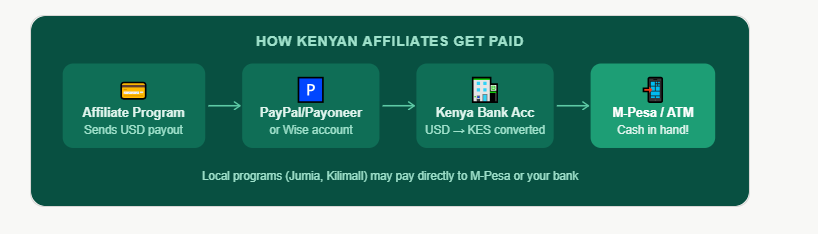
Getting paid is what makes all the hard work worth it, so let’s make sure you have this set up correctly before you even start. The payment process depends entirely on which affiliate programs you’re working with. Local Kenyan programs like Jumia, Kilimall, and local insurance companies typically pay directly via M-Pesa or bank transfer in Kenyan shillings — beautifully simple.
International programs are slightly more complex but still very manageable. Most pay via PayPal — create a verified PayPal account using your Kenyan email and link it to your Equity, KCB, or Co-operative Bank account. PayPal allows you to withdraw directly to Kenyan bank accounts. The transfer usually takes 3–5 business days and the money arrives in KES at the current exchange rate.
Payoneer is even better for many Kenyan affiliates. Payoneer gives you a US bank account number and a Mastercard, so programs that pay via US bank transfer (like Amazon Associates) can pay you directly. You then transfer from Payoneer to your Kenyan bank. Payoneer also integrates with Equity Bank for easier local withdrawals. Many experienced Kenyan affiliates prefer Payoneer over PayPal for reliability and lower fees.
Wise (formerly TransferWise) is another excellent option with some of the lowest conversion fees available. You get multi-currency accounts and can hold USD, EUR, GBP, and KES all in one place. The conversion rates are typically much better than traditional banks. For affiliates earning in USD, the difference in exchange rates between Wise and a traditional bank can amount to thousands of shillings per month at higher earnings levels.
When it comes to minimum payment thresholds, most programs require you to earn at least $20–$100 before they’ll send a payout. This means in your first month or two, your earnings may sit in your account until you reach that threshold. Don’t be discouraged — that’s totally normal. Keep creating content and the balance will grow. Once you start getting monthly payouts, it becomes a very satisfying rhythm.
9. Common Mistakes to Avoid
⚠️ Warning: These mistakes kill most beginners
Most people who fail at affiliate marketing fail for the same predictable reasons. Read this section carefully — it could save you months of wasted effort.
The number one mistake I see Kenyan affiliate beginners make is giving up too soon. Affiliate marketing has a steep “silent phase” in the first 3–6 months where you work hard and see little to no results. This is completely normal. Your content needs time to rank on Google, your social following needs time to grow, and trust with your audience takes time to build. Most people quit in month 2 and never see the results they would have had in month 6. Commit to at least 6 months of consistent effort before judging whether it’s working.
The second big mistake is promoting everything to everyone. Beginners join 20 affiliate programs and shove links into every piece of content, regardless of relevance. Your audience will see right through this and lose trust in you. Instead, be intentional. Only promote products that genuinely fit your niche and that you’d recommend to a friend. Two or three relevant, trusted recommendations convert far better than twenty random ones.
The third mistake is ignoring SEO from the start. Many beginners focus entirely on social media and never build a blog or optimize their content for search engines. Social media traffic is unpredictable and platform-dependent. SEO traffic is consistent, scalable, and yours to keep. Learn the basics of keyword research from day one. Use free tools like Google Search Console, Google Keyword Planner, and Ubersuggest to find the keywords your audience is searching for, then create content targeting those keywords.
- Don’t join too many programs at once — master one first
- Don’t copy content from other affiliates — Google penalizes duplicate content
- Don’t hide affiliate disclosures — it’s unethical and against FTC/ASA guidelines
- Don’t buy fake traffic — it destroys your account and earns nothing
- Don’t ignore mobile users — over 80% of Kenyans browse on mobile phones
- Don’t skip building an email list — it’s your most valuable asset
- Don’t promote products you haven’t researched — you’ll lose your audience’s trust
Another critical mistake is not tracking your performance. Most affiliate dashboards show you clicks, conversions, and earnings per product. Use this data. If one article drives 80% of your traffic but 0% of your conversions, that’s a sign to rewrite it with better calls to action. If one product converts at 15% while another converts at 1%, spend more time promoting the first one. Data-driven decisions separate the affiliates who succeed from those who spin their wheels.
10. Realistic Earnings Timeline
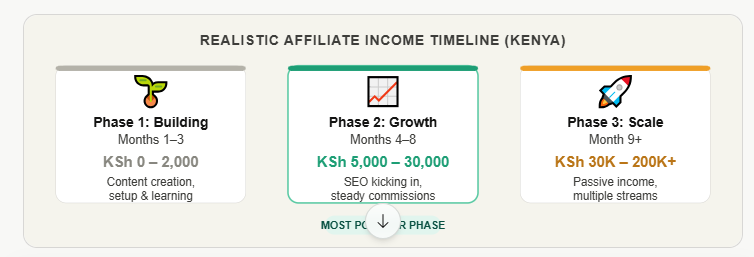
Let me be real with you about earnings — because too many gurus online set unrealistic expectations and leave people feeling like failures. Here’s what a typical Kenyan affiliate marketer’s journey actually looks like with consistent effort.
In months 1–3, you’ll earn almost nothing. You’re in the building phase. You’re setting up your platform, creating content, learning SEO, and growing your audience from zero. This is the hardest phase psychologically because you’re working hard with little visible reward. Most people quit here. Don’t be most people. The work you do in this phase is planting seeds that will grow into a forest. Keep your head down and focus on creating quality content consistently.
In months 4–8, things start to shift. Your older articles begin ranking on Google. Your social media following grows. You’re getting your first commissions — maybe KSh 2,000 here, KSh 5,000 there. By month 6 or 7, dedicated marketers are typically earning KSh 10,000–30,000 per month. This is the phase where motivation really kicks in because you start seeing that the model actually works. You double down on what’s working and cut what isn’t.
In month 9 and beyond, if you’ve been consistent, things accelerate significantly. Your content library is growing. Your SEO authority is building. Older articles are driving consistent traffic. Some affiliates in Kenya hit KSh 50,000–100,000 per month by month 12. A small percentage, who treat this like a real business and invest in learning and scaling, reach KSh 200,000+ within 18–24 months. These aren’t outliers — they’re people who stayed consistent when others quit.
| Month | Activity Focus | Realistic Monthly Earnings |
|---|---|---|
| 1–2 | Setup, niche research, first content | KSh 0 – 500 |
| 3–4 | Content push, social media growth | KSh 500 – 3,000 |
| 5–6 | SEO kicks in, first real commissions | KSh 3,000 – 15,000 |
| 7–9 | Scaling content, optimizing top pages | KSh 15,000 – 50,000 |
| 10–12 | Email list, multiple traffic sources | KSh 50,000 – 120,000 |
| 12–24 | Systematizing, outsourcing, scaling | KSh 100,000 – 300,000+ |
“Affiliate marketing is not a sprint. It’s a marathon where most people drop out in the first 5km. But for those who finish, the prize is a sustainable income that works even when you don’t.”
Ready to Start Your Affiliate Journey?
You now have everything you need to begin. Pick a niche, choose one platform, join one program, and start creating content today. The best time to start was yesterday. The second best time is right now.Get personalized niche advice ↗
Quick-Start Checklist
Use this checklist to make sure you’ve covered all the essentials before you start publishing and promoting:
- Chosen a niche you’re passionate about AND that has money in it
- Signed up for 1–2 relevant affiliate programs
- Set up your blog or social media platform
- Created your affiliate disclosure and privacy policy
- Set up PayPal, Payoneer, or Wise for international payments
- Published your first 5 pieces of quality content
- Installed Google Analytics and Search Console to track traffic
- Started building your email list from day one
- Joined relevant Kenya-based online marketing communities
- Committed to consistent content creation for at least 6 months
Affiliate marketing in Kenya is one of the most exciting opportunities available to young people and entrepreneurs right now. The internet is leveling the playing field — a 22-year-old student in Kisumu can out-earn a corporate professional in Nairobi if they learn the right skills and apply them consistently. The tools are free or very affordable. The programs are open to anyone. And the potential is genuinely unlimited.
The only thing standing between you and your first affiliate commission is action. Take one step today. Choose your niche. Sign up for Jumia’s affiliate program or Hostinger’s affiliate program. Write your first review. Share it on social media. Start the journey. The rest follows from there.