
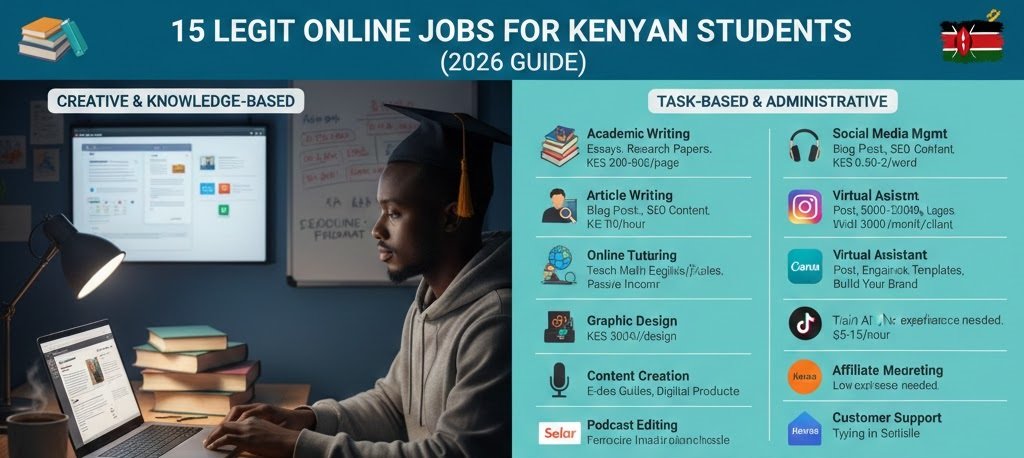
Let’s be honest for a second. Being a student in Kenya today is a balancing act. Between the high cost of living in cities like Nairobi or Juja and the fact that HELB sometimes takes its sweet time to drop, we all need a “side hustle.” I’ve been in your shoes, and I know that the dream is to find something that pays well without making you miss your 7:00 AM CAT.
The good news is that in 2026, the digital economy in Kenya has exploded. Whether you have a high-end laptop or just a decent smartphone, there is money to be made online. You don’t need a degree yet; you just need a stable internet connection and the willingness to learn. I’ve put together this list of 15 legit jobs that are currently paying Kenyan students.
In this guide, I will break down how you can start today, what you need, and—most importantly—how you get paid. Let’s dive into the world of online work and get that M-Pesa message chiming!
1. Academic Writing
Academic writing is probably the most popular “campus hustle” in Kenya. It involves helping students from abroad (mostly the US and UK) with their essays, research papers, and assignments. While there are debates about the ethics, the reality is that it is a multi-million shilling industry in Kenya that employs thousands of students.
To get started, you need to be very good at English and understand formatting styles like APA, MLA, and Harvard. You can find work by opening accounts on platforms like WriterBay or NerdyTurtlez, or by joining Facebook groups where “account owners” hire “writers” to do the work for them. It’s a steep learning curve, but once you master it, you can earn between KES 200 to KES 800 per page.
I always tell beginners to start as a “shadow writer” for someone else. This allows you to learn the ropes without the risk of losing an expensive account. You’ll learn how to avoid plagiarism, how to use tools like Turnitin, and how to structure a 2,000-word essay in a single night.
The best part about academic writing is the flexibility. Most of the work comes in during the “peak seasons” (usually September to December and January to May), which aligns perfectly with the Kenyan semester dates. If you are disciplined, you can make enough in one season to pay your rent for the whole year.
Just remember that this job requires a laptop and very stable internet. You cannot do high-quality academic writing on a phone because of the intensive research required. If you can handle the pressure of tight deadlines, this is one of the most reliable ways to make money as a student.

2. Article and SEO Content Writing
If academic writing feels too “heavy” for you, then article writing is the way to go. This involves writing blog posts, news articles, or product reviews for websites. Every business today needs a blog to rank on Google, and that is where you come in. You write “how-to” guides or listicles that help people solve problems.
I love article writing because it’s creative and less stressful than assignments. You might find yourself writing about “The Best Hiking Spots in Kenya” one day and “How to Fix a Leaky Tap” the next. You can find these jobs on Upwork, Fiverr, or even by reaching out to local Kenyan bloggers who need help managing their content.
To succeed here, you need to understand SEO (Search Engine Optimization). This sounds fancy, but it just means using specific keywords so that people can find the article on Google. There are plenty of free courses on YouTube that can teach you SEO in a weekend. Once you have this skill, your value as a writer doubles.
Payment is usually per word. In Kenya, beginners often start at KES 0.50 per word, but as you get better, you can easily charge KES 2.00 or more. If you write a 1,000-word article daily, that’s KES 2,000 in your pocket every single day. Most international clients will pay you via PayPal, which you can then withdraw to M-Pesa.
Always keep a “portfolio”—a collection of your best work. When a client asks if you can write, don’t just say “yes.” Show them a link to a Google Doc with your best articles. This professional touch is what separates the students who earn “pocket money” from those who earn a full-time salary.
3. Transcription Jobs
Transcription is the process of listening to audio or video recordings and typing out what you hear. It sounds simple, but it requires a lot of focus and a good ear for accents. Many companies, especially in the legal and medical fields, need their meetings and interviews documented in text format.
You can find transcription work on international sites like Way With Words, GoTranscript, or Rev. There are also local agencies like KaziRemote that specifically target Kenyan talent. The beauty of transcription is that you can often do it in short bursts—whenever you have an hour between classes, you can transcribe a 10-minute clip.
To be a pro transcriber, you need a good pair of noise-canceling headphones. If you try to use cheap earphones, you will struggle to hear words over the background noise, which leads to mistakes. You also need to be a fast typer. Most platforms require an accuracy rate of over 95%, so there isn’t much room for typos.
The pay is usually based on the length of the audio, not how long it takes you to type. If you are fast, you can make a lot of money in a short time. For example, transcribing a 1-hour audio file might pay KES 1,500 to KES 3,000. It might take a beginner 4 hours to do that, but an expert can do it in 2 hours.
The main challenge is passing the “entrance test” that most sites have. They are very strict about grammar and punctuation. My advice? Read the platform’s “Style Guide” twice before taking the test. Once you are in, the work is steady, and you don’t have to worry about finding clients every day.
4. Social Media Management
Do you spend hours on TikTok, Instagram, or Twitter? Well, you could be getting paid for that! Many small business owners in Kenya know they need to be on social media, but they are too busy running their shops or offices to post every day. As a student, you are naturally “social media savvy,” making you the perfect fit.
As a Social Media Manager (SMM), your job is to create a content calendar, post updates, and reply to comments. You might work for a local boutique, a car wash, or even a hardware store. You help them look professional and keep their audience engaged. It’s all about building a community around a brand.
I recommend starting with local businesses in your neighborhood or campus. Approach a local cafe and offer to manage their Instagram page for a month for a small fee, say KES 5,000. Use that month to show them how you can bring in more customers through creative Reels and engaging posts. Once you have results, you can charge much more.
Tools like Canva and CapCut will be your best friends. You don’t need to be a professional filmmaker to make a viral TikTok. You just need to know what’s trending and how to use a few simple transitions. Most of this work can be done entirely on your phone while you’re waiting for a lecture to start.
Payment is usually a monthly “retainer.” If you have three clients paying you KES 10,000 each, that’s KES 30,000 a month for work that only takes a few hours of your day. It’s one of the best ways to build a professional network while you’re still in school.

5. Virtual Assistant (VA)
A Virtual Assistant is like a remote secretary. You help busy entrepreneurs or executives with tasks like managing their emails, scheduling meetings, or doing basic data entry. Many of these clients are based in Europe or the US, and they hire Kenyans because we speak great English and our time zone is convenient.
The tasks can vary wildly. One day you might be booking a flight for a client in London, and the next you might be researching the best hotels in Dubai for their upcoming vacation. You need to be extremely organized and good at communication. If you are the type of person who keeps a neat calendar, you’ll love being a VA.
You can find VA jobs on sites like Upwork, Fiverr, or Fancy Hands. There are also specialized agencies like Belay that connect VAs with clients. The pay is usually hourly, ranging from $5 to $15 per hour. For a student, working just 10 hours a week at $10/hour can bring in over KES 12,000 every week!
To get started, you need to be familiar with tools like Google Workspace (Gmail, Docs, Sheets, Calendar) and communication apps like Slack or Zoom. Sometimes, a client might ask you to manage their social media or do some light bookkeeping, so having a broad range of basic digital skills is a huge plus.
The biggest secret to being a successful VA is “reliability.” If you tell a client you will send an email by 5:00 PM, send it by 4:55 PM. Because you are working remotely, trust is everything. Once a client trusts you, they will often keep you on for years, providing you with a very stable income throughout your campus life.
6. AI Data Annotation (Remotasks/Outlier)
This is the “new kid on the block” in the online job world. AI models like ChatGPT need to be trained, and they are trained by humans. Companies like Remotasks, Scale AI, and Outlier.ai hire thousands of Kenyans to look at images, text, or videos and “tag” them so the AI can learn.
For example, you might be shown a picture of a street and asked to draw boxes around all the cars, pedestrians, and traffic lights. Or you might be asked to read two different AI-generated responses and choose which one sounds more human. It is repetitive work, but it requires zero previous experience.
The best thing about data annotation is the low barrier to entry. Most platforms have free training modules. You pass the training, and you start earning immediately. It’s a great option for students who don’t want to deal with clients or marketing themselves. You just log in, do the tasks, and get paid.
However, the pay can be inconsistent. It depends on how many “projects” are available. Some weeks you might make KES 10,000, and other weeks there might be no work at all. It’s best to treat this as a “bonus” income rather than your primary source of cash.
You will need a laptop and a very steady internet connection for this. Many of the tasks involve high-resolution images or videos that won’t load properly on a phone. If you have a few hours of free time on the weekend, sitting down for a “Remo session” can be a very productive way to spend your Sunday afternoon.
7. Online Tutoring
If you are good at a specific subject like Mathematics, Physics, or even English, why not teach it? Online tutoring has grown massively in Kenya. You can tutor primary and high school students in the CBC or 8-4-4 curriculum, or you can teach English to students in countries like China or Spain.
For local tutoring, you can use platforms like Mwalimu Fred Online or even just advertise your services on WhatsApp and Facebook groups for parents. Parents are always looking for affordable “remedial” classes for their kids. You can charge per hour or per session, and the money goes straight to your M-Pesa.
If you want to go international, sites like Preply, Cambly, or italki are great for teaching languages. You don’t always need a teaching degree; sometimes being a native or fluent speaker is enough. Teaching English to a student in Turkey or Brazil can be a fun way to earn $10 an hour while making friends across the globe.
The key to online tutoring is “patience” and “engagement.” You aren’t just reading from a book; you need to make the lesson interesting using digital tools. Use a digital whiteboard or share your screen to show educational videos. If the student enjoys the class, the parents will keep booking you.
You need a quiet place to work, a good webcam, and a decent microphone. Most students prefer video calls, so your background should look professional—a plain wall or a bookshelf works perfectly. It’s a very rewarding job because you’re actually helping someone learn while you earn.
8. Graphic Design (Canva-based)
You don’t need to be a Photoshop expert to be a graphic designer in 2026. Tools like Canva have made it possible for anyone with an “eye for design” to create professional-looking logos, posters, and social media graphics. Many Kenyan SMEs need quick designs for their daily WhatsApp statuses or Facebook ads.
Start by mastering the free version of Canva. Learn about color palettes, fonts, and layout. Once you feel confident, create a “brand kit” for yourself and start offering services. You can design wedding invitations, business cards, or even “thank you” cards for small online shops that sell clothes or makeup.
I recommend specializing in a specific niche. For example, you could be the “Real Estate Poster Guy” or the “Church Flyer Specialist.” When you specialize, people start referring you to others in that industry. You can charge anywhere from KES 500 to KES 2,000 for a single design that might take you 30 minutes to make.
As you get more advanced, you can move into “Motion Graphics”—making simple animated posters or “Intro” videos for YouTubers. These pay much higher than static images. You can find international clients on Fiverr, where a simple logo can sell for $20 or more.
The biggest tip for designers? “Always save your work in a portfolio.” Use a free site like Behance or even just an Instagram page to showcase your designs. When a potential client asks for your rates, send them your portfolio link first. It makes you look like a pro, and pros get paid more!
9. Social Media Community Moderation
Have you noticed how big Facebook groups or Telegram channels can get? They often have thousands of members and can quickly turn into a mess of spam and insults. Brands and influencers hire “Community Moderators” to keep these spaces clean, helpful, and safe.
Your job as a moderator is to approve or decline posts, delete spam, and make sure everyone is following the rules. You might also be asked to answer basic questions about a product or service. If you like hanging out in online communities, this is a very easy job to do from your phone.
You can find these roles by looking at the “Careers” pages of tech startups or by reaching out to Kenyan influencers who have large followings. Many crypto projects and gaming communities also hire remote moderators to work in different time zones. Since Kenya is 3 hours ahead of London, we are often hired to cover the “night shift” for Western companies.
The pay is usually hourly or a monthly stipend. It’s not the highest-paying job on this list, but it’s very low-stress. You can moderate a group while watching a movie or sitting on a bus. It’s perfect for students who want a “low-effort” hustle that doesn’t interfere with their studies.
To be a good moderator, you need to be “fair but firm.” You can’t let your friends break the rules, and you have to be quick to spot scammers. It’s a great way to learn about online marketing and how people behave on the internet—skills that are very useful for your future career.
10. Affiliate Marketing (Jumia/Amazon)
Affiliate marketing is simply “referring and earning.” You promote a product using a special link, and if someone buys it using that link, you get a commission. In Kenya, the Jumia KOL (Key Opinion Leader) Program is the most popular way to start.
You don’t need to buy any stock. You just find a product on Jumia—maybe a cool pair of sneakers or a cheap smartphone—and share your link on your WhatsApp Status or TikTok. If your classmate sees the status and buys the shoes, Jumia pays you a percentage of the sale (usually 2% to 10%).
The secret to big money in affiliate marketing is “honesty.” Don’t just spam links to random products. Only recommend things you actually like or that people are looking for. If there’s a big sale coming up, like Black Friday, prepare your links in advance and help your friends find the best deals.
You can also join international programs like Amazon Associates, though getting paid from them in Kenya requires a bit more setup (like using Payoneer). There are also local companies like Collanet Africa that pay you to refer students to their educational resources.
The beauty of this is that it’s “passive income.” You post a link once, and it can keep making you money while you sleep. Some Kenyan students have built entire niche websites or TikTok accounts just for reviewing products and sharing affiliate links. It takes time to build, but the potential is huge.

11. Selling Digital Products (Selar/E-books)
Why work for a boss when you can sell your own products? Digital products are things like e-books, study guides, or even Canva templates. The best part? You create them once and sell them a thousand times with zero extra cost.
As a student, you have unique knowledge. Are you great at a specific course? Create a “Student’s Guide to Accounting 101” and sell it to the freshmen. Are you a fitness junkie? Sell a “30-Day Home Workout Plan for Busy Students.” You can use a platform like Selar to host your products—they handle the payments and even allow your customers to pay via M-Pesa.
Marketing is the most important part here. Use your TikTok or Instagram to share “tips” related to your product. If you’re selling a study guide, share “5 Study Hacks that Helped Me Get an A.” At the end of the video, tell people they can get the full guide via the link in your bio.
This is a great way to build a personal brand. Even if you only sell your e-book for KES 200, if you sell to 100 students, that’s KES 20,000. It teaches you about sales, marketing, and customer service—lessons that you won’t always find in a classroom.
Don’t worry about being “perfect.” Your first e-book might be simple, and that’s okay. The goal is to start. As you get feedback from your customers, you can improve your products or create new ones. It’s one of the most fulfilling ways to make money online in Kenya.
12. TikTok and YouTube Content Creation
In 2026, content is king. If you can make people laugh, teach them something, or just entertain them, you can build a massive audience. TikTok has recently made it easier for Kenyan creators to monetize through the TikTok Creator Fund and “Live Gifts.”
YouTube is still a powerhouse for long-form content. If you have a passion for cooking, tech reviews, or even “vlogging” about student life at Kenyatta University, start a channel. Once you hit 1,000 subscribers and 4,000 watch hours, you can start earning from ads. Plus, local brands will pay you for “shoutouts” or sponsored videos.
The biggest mistake students make is thinking they need a “studio.” You don’t! Your phone camera is enough. The most important thing is “consistency.” Post once a day on TikTok or once a week on YouTube. Use trending sounds and engage with every single comment to build a loyal fanbase.
You can also use your platform to sell your other services. If you’re an article writer, make videos about “How to become a freelancer.” This builds trust, and soon people will be asking to hire you. It’s about creating an “ecosystem” where your content supports your work and vice versa.
Keep in mind that this is a “long game.” You might not make a cent for the first six months. But if you stick with it, content creation can become a career that lasts long after you graduate. Some of Kenya’s biggest influencers started right in their hostel rooms!
13. Podcast Editing and Production
Podcasting is booming in Kenya right now. Everyone from celebrities to business coaches is starting a podcast. But here’s the thing: most people hate the technical side. They don’t want to spend hours cutting out “ums” and “ahs” or trying to make the audio sound clear.
If you have a laptop and can learn simple software like Audacity or CapCut, you can offer podcast editing services. You take the raw recording, clean up the sound, add some intro music, and deliver a polished episode. You can charge per episode, with rates in Kenya ranging from KES 2,000 to KES 10,000 depending on the length.
You can find clients by looking for new podcasts on Spotify or YouTube and sending them a polite email. Offer to edit their next episode for free as a trial. If they love the result, they will likely hire you as their permanent editor. It’s a great way to get a “behind-the-scenes” look at how successful people think.
Besides editing, you can also offer “Podcast Management.” This includes writing the episode descriptions, creating “audiograms” (short clips for social media), and uploading the files to platforms like Anchor or Spotify. It’s a full-service package that busy creators are happy to pay for.
This job is perfect for “introverted” students. You don’t have to be on camera or talk to many people. You just put on your headphones and get into the “flow” of editing. It’s creative, technical, and in very high demand right now.
14. Remote Customer Support
Many international e-commerce companies and tech startups need people to handle their “live chat” or email support. They want people who are polite, fast at typing, and have good problem-solving skills. Since these companies operate 24/7, they often have “night shifts” that are perfect for students.
You might be helping a customer track their package, resetting a password, or explaining how a refund works. Most companies provide you with “scripts” and a knowledge base, so you don’t have to know everything off-head. You just need to be able to find the information quickly and explain it clearly.
Platforms like M-KOPA, Safaricom, and international sites like Working Solutions often hire remote agents. You can also find these roles on LinkedIn by searching for “Remote Customer Support” and filtering for “Entry Level.” The pay is usually a fixed monthly salary, which is great for budgeting.
You need a quiet workspace and a good headset. If you are doing chat support, you can even do it from a library! It’s a very professional role that looks great on your CV. It shows future employers that you can handle responsibility and work in a high-pressure environment.
The key to success here is “empathy.” Customers are often frustrated when they reach out. If you can stay calm and be genuinely helpful, you will get great ratings, which often leads to bonuses or promotions. It’s a solid, “corporate” style job that you can do from your bedroom.
15. Data Entry
Data entry is the classic online job. It involves taking information from one place (like a PDF or a handwritten note) and typing it into another (like an Excel sheet or a website). It doesn’t require high-level skills, but it does require extreme attention to detail.
You can find data entry tasks on ApexListings, Upwork, or Fiverr. Sometimes local businesses need help “digitizing” their records. For example, a small clinic might hire you to type up their patient files into a computer system. It’s simple work that pays decent “pocket money.”
The main risk with data entry is “scams.” If a job asks you to pay a “registration fee” or “security deposit” before you start, it is 100% a scam. Legitimate employers will never ask you for money. Always do your research before sharing any personal information.
To earn more in data entry, learn how to use Advanced Excel. If you can do things like VLOOKUPs or Pivot Tables, you can charge much more than someone who just types. There are thousands of free tutorials on YouTube that can make you an Excel wizard in a week.
While data entry isn’t the most exciting job, it’s a great “starter hustle.” It helps you get used to working online, hitting deadlines, and managing your time. Once you’ve mastered data entry, you can easily transition into more complex roles like Virtual Assistant or Data Analyst.
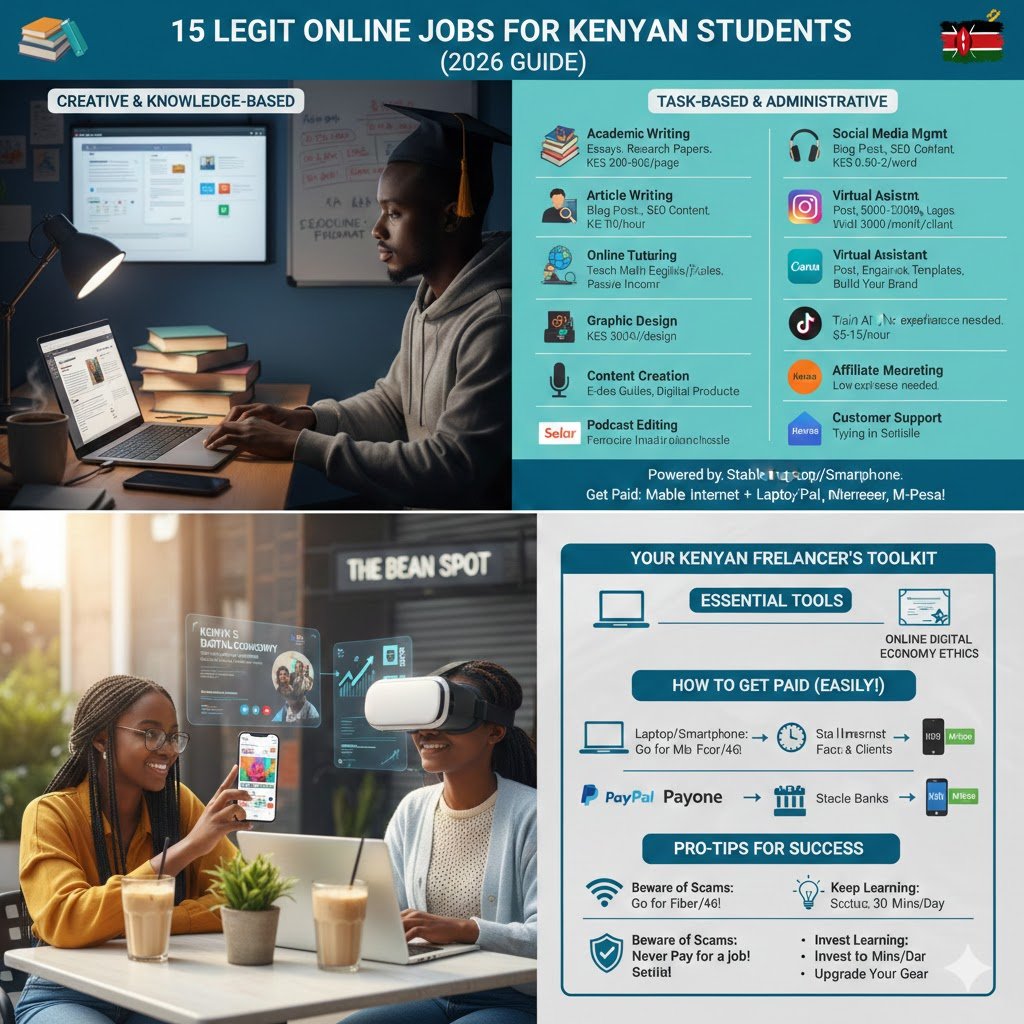
How to Get Paid: The Kenyan Freelancer’s Toolkit
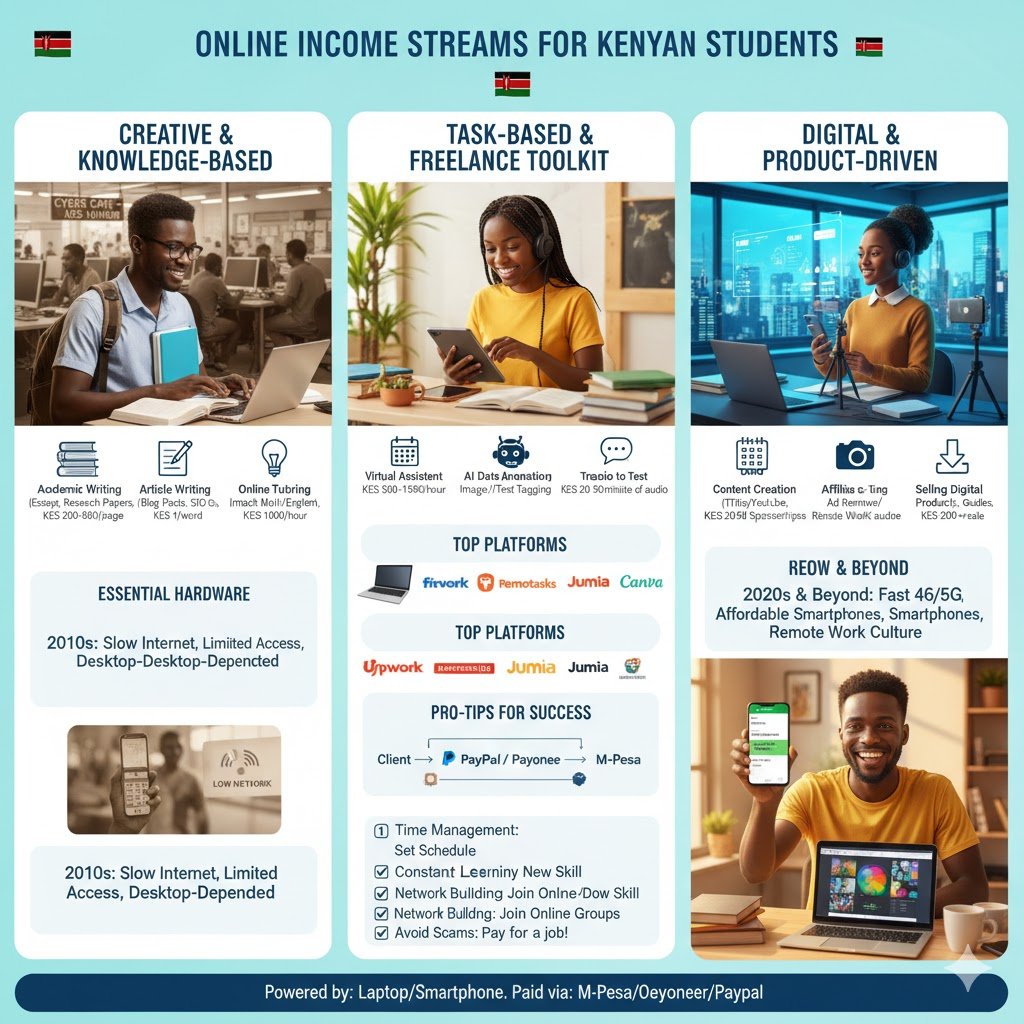
Working online is great, but getting that money into your pocket is what matters. In 2026, the process is smoother than ever. Most international clients will pay you via PayPal, Payoneer, or Skrill. From there, you can link your account directly to M-Pesa and withdraw the funds in minutes.
For local clients, M-Pesa is obviously the king. I recommend getting a “Till Number” or a “Lipa na M-Pesa” account if you are selling products—it looks more professional than just using your personal number. Always keep a record of your earnings so you can track your progress!
Final Pro-Tips for Success:
- Set a Schedule: Don’t let your side hustle kill your GPA. Dedicate specific hours to work and specific hours to study.
- Invest in Your Tools: As soon as you make your first KES 20,000, buy a better laptop or a faster internet router. Better tools make you more efficient.
- Watch Out for Scams: If it sounds too good to be true, it probably is. Never pay to get a job.
- Keep Learning: The digital world moves fast. Spend 30 minutes every day learning a new skill on YouTube or Coursera.
This video is incredibly helpful for Kenyan students because it shows a step-by-step way to set up an online store on Selar, a platform that supports M-Pesa and is perfect for selling simple digital products like class notes or guides.